
Psi research has always faced a structural problem.
It is not primarily belief. It is not primarily statistical debate. It is not even primarily selective reporting.
The deeper issue is verifiability.

In conventional research, even when conducted by reputable scientists, the public must ultimately accept an element of “trust us, we followed the protocol correctly.” Data are published. Methods are described. Peer review is applied. But the evidentiary chain still depends on institutional credibility and post hoc documentation.
For ordinary scientific domains, that may be sufficient. For highly controversial and historically ridiculed phenomena like psi, it is not. The credibility threshold is higher. And it should be.
Psiscope recognized this nearly a decade ago, identifying blockchain-based smart contract systems as the logical solution — with the years since devoted to making that solution practical and usable. (Check out our 2022 article “Psi Revolution via Blockchain” in the “Eight Martinis” remote viewing magazine.)

–
The Verifiability Problem
Both academic psi research and independent practice face the same structural limitation: results are recorded within systems that require trust.
In research settings, critics question:
- Whether pre-registration was truly binding
- Whether data handling was strictly neutral
- Whether subtle experimenter effects were controlled
In practitioner settings, concerns often focus on:
- Private sessions with selective sharing
- Limited access to full performance histories
These concerns persist not necessarily because of misconduct, but because traditional infrastructures were never designed to eliminate doubt under adversarial scrutiny.
Psi has relied on reputation, institutional affiliation, or personal credibility. What it has lacked is trust-minimized architecture.
–
Why Onchain Infrastructure Changes the Equation
Blockchain technology — more precisely, smart contracts operating on a blockchain — introduces a structural shift.
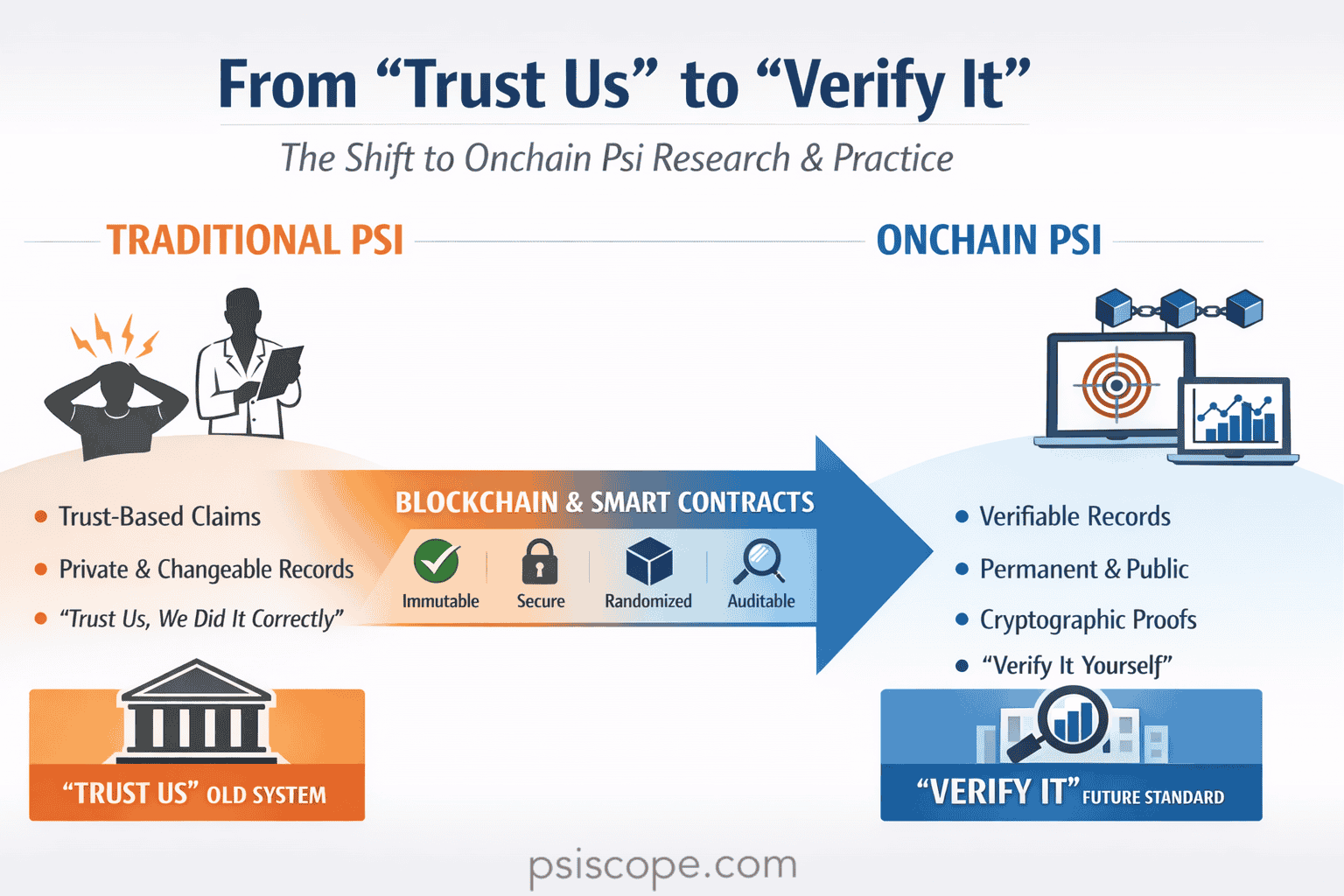
Smart contracts are self-executing rules that cannot be altered retroactively once deployed. When trials are governed by such systems:
- Commitments are timestamped and immutable
- Procedures are locked in advance
- Outcomes cannot be quietly modified
- Records remain publicly auditable
While this does not replace statistical analysis or careful protocol design, it strengthens them immensely in a way that was not possible before.
For researchers, it provides a form of methodological anchoring that goes beyond lab documentation. For practitioners, it removes selective reporting by design. For observers and skeptics, it offers direct access to primary records rather than summarized claims.
In other words, it shifts psi from “trust us” toward “verify it.”
And if psi is real — as decades of accumulated research strongly suggest — sufficiently large, transparently recorded onchain datasets will make that increasingly difficult to dismiss.
Onchain infrastructure does not argue for psi. It creates the conditions under which psi can prove itself.
–
Preparing for the A.I. Era
Artificial intelligence is advancing rapidly. It may assist with judging, analysis, and protocol design. But it also makes fabrication and post hoc narrative construction easier.
In such an environment, cryptographically anchored timestamps and immutable commitments become more important, not less.
Onchain systems establish:
- When a psi session data was committed
- Under what rules
- That the record has not been altered
Going onchain is therefore not about trend adoption. It is about securing evidentiary foundations before digital ambiguity becomes the norm.
–
Consistency and the Power of a Track Record
Most people will not become elite remote viewers. But many have the potential to become consistent performers under structured conditions.
Consistency, whether in laboratory research or independent practice, requires cumulative, transparent tracking. Not isolated successes, but sustained performance over time.
Onchain systems, such as Psiscope’s latest rank-order trials app, enable:
- Permanent performance histories
- Automatic documentation of trials
- Transparent aggregation of results
- Publicly verifiable statistical records
Over time, this produces something especially valuable: a verifiable track record.

For practitioners, such a record functions almost like a professional resume — a documented history that can support collaborations, research participation, or business opportunities.
For researchers, cumulative onchain datasets strengthen proposals, facilitate cross-institutional collaboration, and allow independent reanalysis without relying solely on trust in reporting.
The emphasis shifts from dramatic single sessions to sustained reliability.
And sustained reliability would not only build credibility but also lead to real-world applications that makes tangible differences in the world we live in.
–
PSISCOPE
As the pioneer of the onchain psi approach, Psiscope has focused consistently on integrating psi and blockchain starting around 2017. Through multiple iterations, the emphasis has remained the same: verifiability first.
Psiscope’s framework reflects in part:
- Permanent, publicly auditable records
- Smart contract–governed trial structures
- Cryptographically verifiable randomness using VRF
- Long-term statistical tracking
Significant effort has also gone into usability. In the latest iteration, for example, users no longer need browser wallet plugins, seed phrases, or crypto expertise thanks to account abstraction. Participation feels like using a conventional website, while the smart contract infrastructure operates securely in the background.
It’s important to make the process as accessible and practical as possible without sacrificing trustless verifiability and we have now achieved this objective thanks to continuing advancement in Web3 technology.
The use of Verifiable Random Function (VRF) for trustless randomness is another game changer Psiscope recently introduced with the latest iteration, solving the surprisingly challenging issue of producing randomness people can trust 100% (i.e. “trustless”).
All in all, it has never been easier to join the onchain “psi revolution” than today and the best way to be part of it early is to start building an onchain track record – your psi “resumé” – using Psiscope’s latest Rank-Order Psi Trials web app.

It is future-proof and it is in fact the world’s first and only fully trustless (trust free) psi trial system in existence. With it, you can create a solid foundation for your future psi career and the faster you begin the better your prospects will be.
–
The Inflection Point
Psi stands at a historical threshold.
Artificial intelligence is accelerating humanity’s capacity to simulate, predict, and replicate patterns of mind. As machine cognition expands outward, questions about the nature and limits of consciousness grow more urgent. In that context, psi is no longer a fringe curiosity. It becomes a frontier question.
Onchain infrastructure does more than strengthen methodology. It prepares psi to participate in that larger conversation.
If psi is real, proving it under transparent, adversarial, technologically rigorous conditions will not be the end of the story, it will be the beginning. It will shift discussions about mind, information, causality, and the structure of reality itself.
In a world increasingly shaped by artificial systems, demonstrating expanded capacities of human consciousness carries cultural and philosophical weight far beyond the field of parapsychology.
Going onchain is not simply about better record-keeping. It is about positioning psi for the era now unfolding.
The future of psi is onchain. And the time to build that future is now.
– Goro (Feb 14, 2026)