
Demystifying Psi Projects
Beyond the on-chain (and off-chain) trials, we have a special setup called “projects” – traditionally known as “associative remote viewing” (ARV) – all about applying psi directly to real-world situations, no longer focused on proving psi but actually using it “outside the lab” thereby injecting the new reality into the existing reality. This is where the rubber meets the road, and if successful, where we begin to make a tangible impact on human society.

Psiscope ARV system highlights:
- A full-fledged ARV system that has everything you need to start and manage projects properly and with ease
- Target candidates are randomly selected and algorhythmically filtered to avoid combinations suboptimal for ARV
- You can easily create, manage, and assign teams for projects
- Email notification system makes sure members are kept updated on their team projects’ status
- Charts are automatically generated to show consensus/trends and assist decision making
- You have an option to record project predictions on blockchain, making them provable
- You can set a deadline for your projects with a countdown clock
- You can set a preferred blinding level for your projects (i.e. how much detail is visible to participants)
- You can set a preferred privacy level (how visible your projects are to others)
- You can show your project page to anyone outside (and invite them) at any stage, regardless of their membership, if set to “public” or “open”
——
A step-by-step guid follows below.
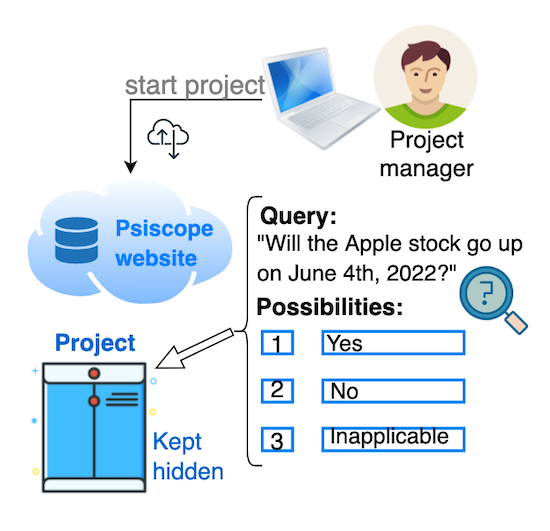
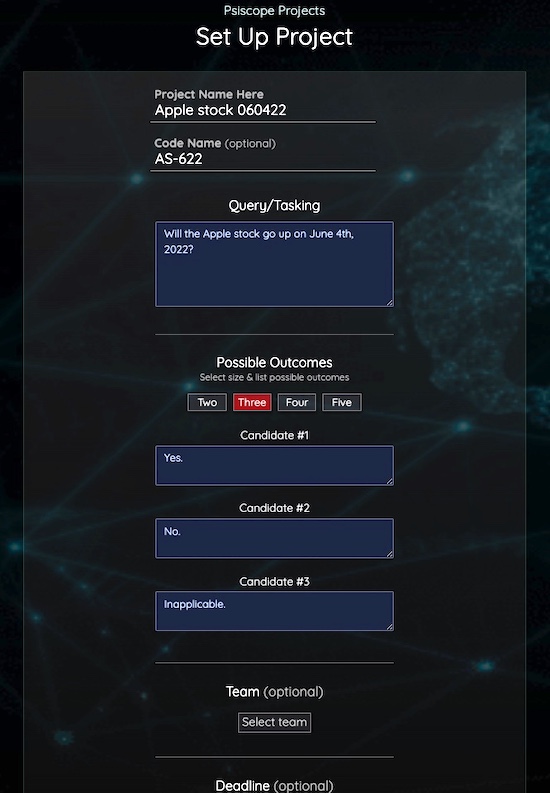
Step 1: A project manager sets up a project by specifying a “query” (or “tasking”) and a set of possible outcomes. Basically a question/task and a list of possible answers. The purpose of a project is to predict – using psi only – the correct outcome or determine the correct answer (if not a prediction per se). Ideally the details of a project are kept hidden until the project has stopped collecting psi data thereby maintaining a strict blind condition for all participants besides the project manager. You can, however, run a project with known details as well while maintaining a sufficient level of blinding thanks to the way each “session” is set up with hidden “associations” (see Step 2).
Step 2: Invite people to participate and/or assign an existing team to the project. (You may choose to do it all by yourself.) When a participant comes to the “project page” s/he is invited to do a “session” for the project. Thereafter the process is nearly identical to the trials without the blockchain part.
Sequentially: 1) The participant is shown a TRN (“target reference number”) to focus on, 2) s/he tunes into the target and acquire psi impressions, 3) the target “candidates” (different for each participant) are disclosed, 4) the participant ranks them based on his/her psi impressions.

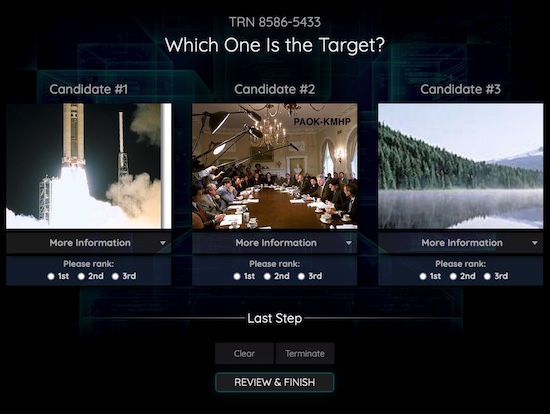
Under the hood, each of these “candidates” is randomly associated with one of the possible outcomes/answers. (The order is shuffled.) The participant, understanding this on a sub/unconscious level, should in theory be able to rank the candidates accordingly using psi only i.e. ranking higher the candidates that correspond better to the correct/most likely outcome. The participant does not need to understand any of this on a conscious level; the process works fine either way.
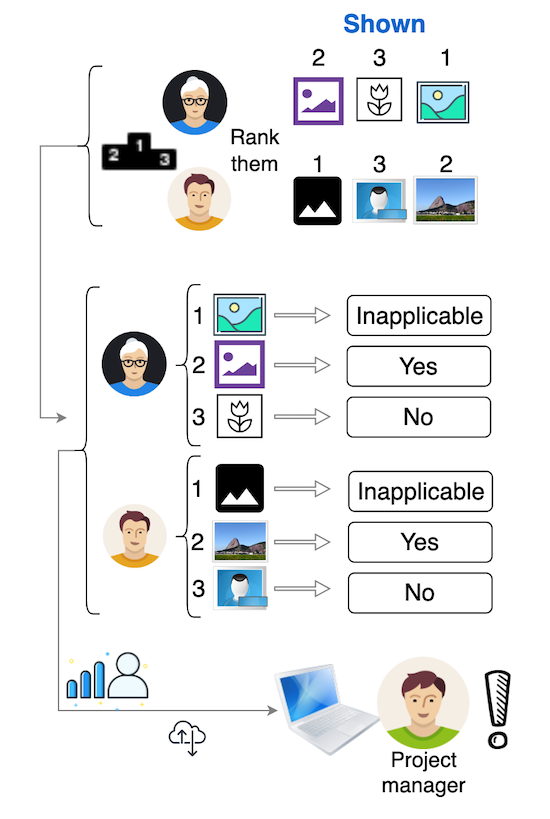

Step 3: During the preceding steps the system collects ranking data from participants which are automatically sorted and counted like votes in an election. (Charts are automatically produced.) Which candidate/possibility got the most “votes”? Which came in second? What about the participants’ confidence level? What about their track record? All these and other factors may be taken into account when deciding on the final prediction/answer.

Step 4: Once committed to a decision, the final prediction is recorded on the Psicope database with a timestamp. At this point the project manager may choose to put the prediction on the blockchain thereby making it provable to others.
Step 5: Wait for the outcome/answer to materialize in reality. When it does, the project manager is to put that final piece of the puzzle into the project, which the system sees and judges i.e. success or failure. And that is the end of the project. (Note: Ideally the final step should be done in a more decentralized, trustless way. Something that Psiscope is looking to implement sometime in the future when the blockchain/Web 3 technology is more mature and easier to handle.)
# # #
So what can you do with such projects? Well, how big is your imagination? Simply put, the sky is the limit. As they say, big things have small beginnings. This is only the beginning of a reality revolution.

+ – + – +
[You can test drive an open project here]